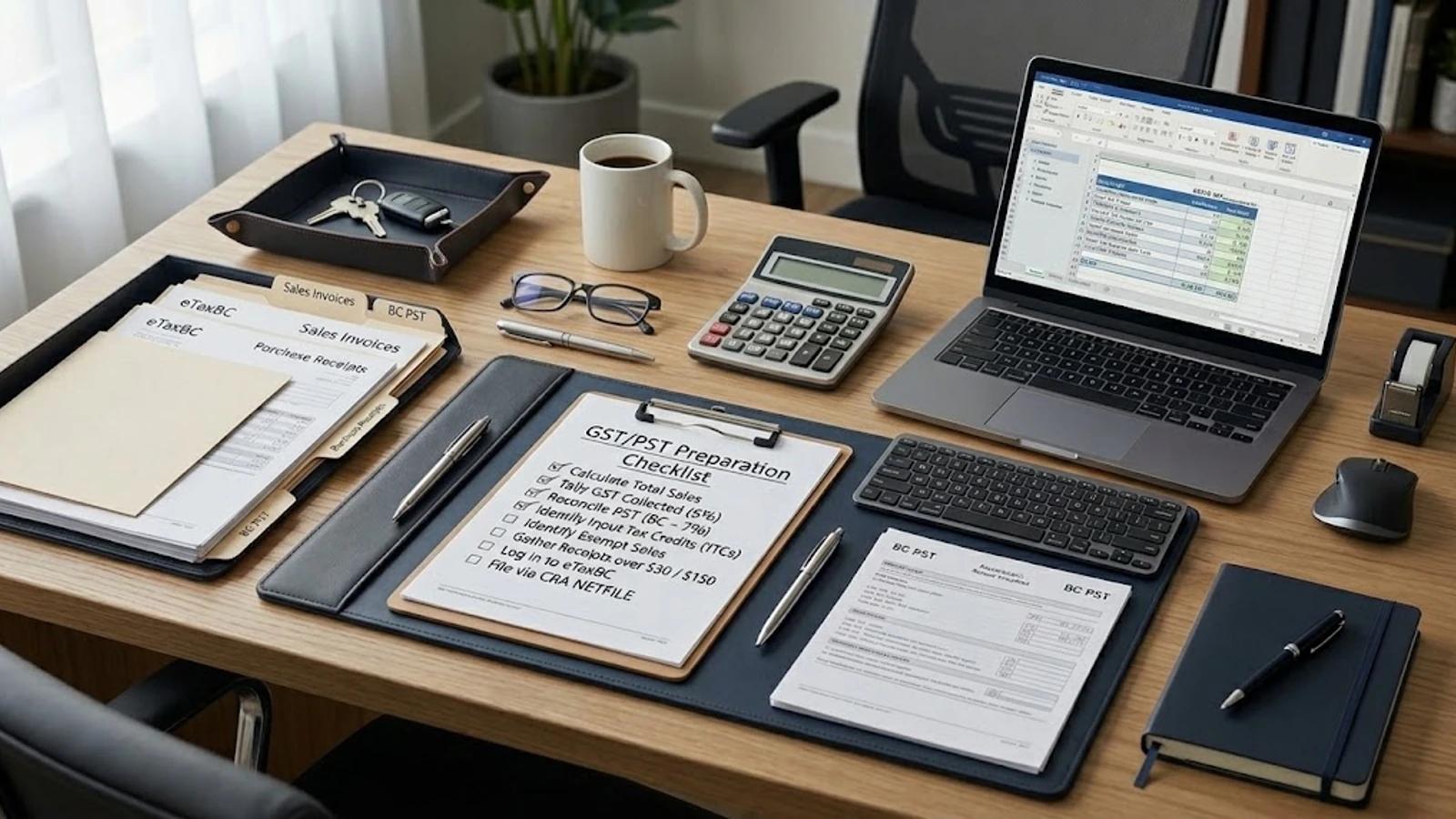
If you are gathering records for GST/HST, BC PST or both, start by identifying the program each record supports. For a BC business, GST/HST is a federal tax administered by the Canada Revenue Agency, while PST is administered by the Province of British Columbia. Their accounts and returns are separate. This guide is about organizing information, not deciding which accounts your business needs.
Key points
- Keep GST/HST and BC PST identifiable in your records instead of combining them into one tax total.
- A purchase document supports a review; it does not make every tax amount recoverable.
- Check the reporting period for each account rather than assuming the dates match.
- Confirm who prepares, approves, files and pays before a reporting period is treated as complete.
Keep the two programs distinguishable
Use a record layout that lets you identify each tax amount and follow it back to the transaction. For example, discuss separate tax columns or account codes with your bookkeeper. These are suggested ways to organize records, not instructions to open another bank account or buy different software.
| Record question | GST/HST | BC PST |
|---|---|---|
| Which account? | The relevant federal GST/HST account. | The relevant provincial PST account. |
| What about purchase tax? | Review possible input tax credits under GST/HST rules. | Keep PST purchase obligations and any exemption or refund support distinct. |
| Which dates? | Check the account's GST/HST reporting period. | Check the account's assigned PST reporting period independently. |
Start with sales and supporting documents
For your preparation file, gather sales invoices, credit notes, refunds and sales-system reports for the period. Keep a way to trace summary figures back to individual documents. Identify GST/HST and PST separately where they appear, and flag documents with unclear tax treatment rather than deciding the treatment from a total alone.
If you file a GST/HST return, CRA guidance requires records describing the goods or services in enough detail to determine whether GST/HST applies. The BC guide also addresses sales and purchase records and evidence supporting exemptions. A useful handoff therefore includes the underlying documents, not just a spreadsheet containing tax totals.
Gather GST/HST purchase support for ITC review
An input tax credit, or ITC, can allow an eligible GST/HST registrant to recover GST/HST paid or payable on qualifying purchases connected with commercial activities. It is not an automatic credit for every purchase. Eligibility, use of the purchase, claim timing and the accounting method can affect the result.
CRA requires sufficient supporting documentation before an ITC is claimed. Gather the original invoice or receipt information, including supplier, date, description, amounts and tax details, and request missing information where needed. Check the supplier's GST/HST registration information where relevant to the claim. The precise requirements vary; this suggested collection list is not a substitute for checking the documentation rules that apply to a particular claim.
Keep BC PST purchase questions separate
BC PST does not have the GST/HST input-tax-credit system. Specific exemptions or refunds may apply, but each has its own conditions. Keep the relevant purchase records and any exemption or refund support together rather than treating PST paid as a GST/HST credit.
If PST is payable on a purchase and the seller has not charged it, BC requires the purchaser to self-assess, meaning pay that PST directly to the province. An invoice without PST is therefore a question to check, not proof that no PST is due. Flag the purchase and its intended use for assessment; this article does not determine the taxability of that transaction.
Check periods and assign the next steps
GST/HST and PST reporting periods follow their respective program rules. Check each account's actual period and note any changes. Do not copy the dates from one return onto the other without checking them. For industry-specific questions, check current provincial notices as well as the linked guidance.
For your own tracking, distinguish records assembled, questions resolved, return approved, return filed and payment arranged. Preparing a return and paying an amount owing are different tasks. Confirm who handles each step and retain the relevant confirmation in that account's file.
Your sales-tax records checklist
- Identify the account and reporting period for each program involved.
- Gather sales invoices, credit notes, refund records and supporting sales reports.
- Keep GST/HST and PST amounts distinguishable in transaction records.
- Assemble purchase documents and missing-information requests for ITC review.
- Flag purchases needing PST assessment and collect applicable exemption or refund support.
- Provide prior returns and account information relevant to unresolved differences.
- List outstanding treatment questions and confirm approval, filing and payment responsibilities.
Scope and a practical next step
For help, describe which accounts and periods need attention. MH Ledger&Co Ltd. confirms sales-tax preparation, authorizations, filing steps and payment responsibilities within the agreed scope; preparation does not mean we automatically remit funds. Monthly bookkeeping support is a separate way to organize the underlying records. Use the inquiry form for a summary only, without account credentials or financial documents; agree on a secure sharing method separately.